Showing posts with label fitting. Show all posts

Friday, 23 December 2016

Fitting Alignment Issue

What’s wrong with these fittings?
 
Weird alignment

weird again.


My fitting orientation is all wrong.  You will get this especially on zero dead leg valves for pharmaceutical products but I’ve seen this on other products.

If you create a plane between the 3 connection points of the valve you will see that it’s not parallel with the rest of the geometry, valve body in my case.

default orientation

The direction is given by the 3’rd connection perpendicular to the line between the first and second. I think this is to help out with inexperienced users, idiot proof really, helping out if you didn’t align your connections to the model but that's just for straight fittings like tees.

Now what? Am I supposed to measure the angle every time and change fitting orientation on a continuous loop? (rolling eyes).

In order to fix this you need to add another authoring point and make it a 4 point connection.

4 Connections on a 3 point fitting? Are you mad?

I thought we already established that and we’re here to have some fun and solve some problems.

 We will be creating the 3rd connection inline (same plane) and parallel with the fitting as spare, never to be used and instead the 4th connection is to be used.

It might help to make the 3rd on a different plane away from 4th like right on the origin line just so it’s out of the way when placing or connecting fittings to it. We want to make it very obvious from the snap preview that it’s not the one to be used.

authoring dialog window

I have also gave it a really small connection size; a size we would never use like 1/8” to differentiate it even more and keep people from connecting to it.

And this is what the difference between placing a 3 or 4 connection fitting looks like
 
compare the results.
I’ve given this example before on autodesk forum on a similar issue.

You can keep just 3 connections if you align the third but we can do better.

3 would do but 4 is better


I feel it’s best to have a 4’th connection but be careful on placing fittings.

Watch out for ghost connection when placing this fitting. 

Later,
ADS


Monday, 4 July 2016

Fitting Engagement Distance


This has been in my drafts way to long. I only allowed myself to publish new posts if there is one ready to go in my drafts. Even though I am not back to normal I feel this might help me move towards normality even if I might never get there again.


Can fittings have both male/female connections and different engagement distance?


My friend asking this was referring to elements like bushings, and reducers as in the image bellow where the right side connection can fit 2 sizes, one inside (female) and one outside (male). These will need different engagement distances as well.

3 connections on same fitting.
Library or stand alone?


There is no gender on the fittings; they are all connected by points and axes but how you author it depends on what you intend to do with the file. Is this for an ipart to be published to Content Center, or is it a standalone library file?

More than likely this will be used in content center but if this is a standalone library then you need to author this in a weird way with 3 connections instead of 2. When you place the fitting press Spacebar until it shows the correct position.

While this is possible I think most of you will need this in Content Center. For that you will create two identical shape members with different connections.

Even though these members will have identical part number, stock number and whatever fields you use to identify this, the filename needs to be unique. This is one rare occasion when I allow filename to be different than the part number.

How do we create a dynamic engagement distance? You create an offset work plane and you control the offset value from the ipart table.
 
offset plane
 
ipart table

In the author fitting window choose Engagement, To Plane, Point and choose our plane.

 
Authoring, To Plane / Point
Later,


ADS.


photo credit: parts (license)

Thursday, 28 January 2016

Publishing Dumb Parts

This is last part of the series, covering how to publish dumb parts to Content Center. Now you know where to get parts on the internet, how to create work features, and how to author empty parts. This is all neded info before we take the final step.

                Quite simply publishing dumb parts as a family in content center is based on the ability to create iparts with suppressed bodies (will expand later).
Downloaded parts can stay dumb, we'll make them smart.
                As you probably know if you follow this blog when I download parts from the internet I don’t publish them to content center but I keep them in a library folder and the document properties are saved in a text file. When I need to place a certain valve I copy the file path from the text document, and I paste it in the place fitting dialog window to speed up my navigation time. Content center seems slow as it is and I don't want to overload it with individual parts.

                While placing from disk is faster than placing from content center (it is for me) there is another limitation that we can’t overcome. Insert fittings only seems to work with content center items, parametric or dumb all the same. If you don’t know what I just said I suggest you get familiar with my blog on inserting fittings here.

Placing fittings will insert nodes on the route which breaks constraints and remove dimensions. A better way would be to place the main fitting say a valve and insert the rest of the fittings before and after, like reducers, unions, etc. This way you only need to control the position of one node on the route and the sketch remains fully constrained. Insert fittings only works with content center items and to overcome this you would first need to place a CC item and then drop your library item (located on disk) over that CC item. These are way to many steps, so for this we will publish them to CC as a family.

I am going to use a Georg Fischer valve set as an example.
TIP: You can download the whole Georg Fischer cad files as zipped packages split by material type, ABS, PVC-U, PVDF, etc.

Georg Fischer metering valve as example.
I needed a metering Valve so, to replicate my case,  after locating the stp files start a new assembly in Inventor. Drag the step files inside the graphical window of the new assembly. If the files are computer generated then the origin will match for every single one of them even though when they are dropped in the assembly they will be automatically positioned at certain distance from one another. You need to position them on a common origin, and even better to the origin of the assembly. Use the Assemble tab, Productivity pane, Ground and Root Component command to fix them at the origin really quick. As you can see in the screenshot I have GR as my speed key and that helps a lot.

TIP: The files will be imported as per the last Options you chose for this particular foreign file extension. If they are being imported as composite surfaces rather than parts with bodies read down towards the end how to change the import options.
 
Use Ground and Root Component to fix them at origin.
This is a perfect example because with 2 models we are going to cover 4 members in content center. Because the models are the same there is no point getting all 4 stp files and only 2 will do. The other 2 models are identical having different part number due to different gasket materials.

If the models had a common origin you should see them overlapping just like on my section in the image bellow. If not you will have to constrain them to a common origin, and then to the assembly origin.
Locate imports on a common assembly origin.
The next step is to get this assembly as a single multi-body part because for now it’s only parts that can be authored as T&P and parts only that can be published to CC. Derive and Shwrinkwrap didn’t worked in all my tests because the bodies were not coming in as suppressible features. Save the assembly as “stp” because “sat” for all my tests looses the color of the bodies and I don’t want to fix appearances as well. Click open and browse to the new stp. location.  You might need to change the file extension filter to Step or Any (*) and select your file. Click Options next to Open and then make sure you choose Solids, Assembly as Single Part and Multiple Solid Part. This will allow you to suppress the bodies unlike doing a shrinkwrap or derive.
Shrinkwrap or Derive didn't worked for me.
Use the Options button before Opening the document.
TIP: If you don't get solid bodies on your imports you can play with stitch, sculpt, combine, and get solids out of surface bodies, but we do need bodies for the suppress command.
In the part environment use Parameters and add two parameters, z and L (my case) which will be your connection distance and engagement distance. For butt weld you don’t need an engagement distance. Just like in authoring empty parts we will create work points for our connection reference using work planes located at L/2 on each side and the inline origin axis. As you can see the catalog has no dimensions for z but I have measured the models and added the value to the table.
Missing dimensions can be measured on imported models.

Create connection points using parameters.
Before you click the create ipart button I suggest you rename the bodies in the browser because they will be hard to identify on the ipart table. Here’s my example, and remember that a single body will serve 2 family members. If you don’t do this, in the ipart table you will see “body1”, “body2”, etc. which is hard to locate.
Rename bodies to make easier to identify in the ipart table.
Once finished adding the ipart table info test the model by switching between ipart members and see if the model updates. I have an excel spreadsheet as template for Georg Fischer families and once I’ve clicked on create ipart, I close the table without edits and I open it in excel where it's easier to paste the data from my template which covers, material, description, DN, part number, etc.. and even cost and stock info.
Test your model by switching between components.
Author the ipart as Tube and Pipe component using the connection points created and the “To Plane / Point” option choosing the engagement planes.
Author and publish your part to Content Center
Once you publish this to Content Center you have access to Change Size command but most important the Insert Fitting command.
Insert Fitting is working for CC items.

Keep in mind that adding all these bodies will increase the size of the file a lot and for simple parts you are better off to model it rather than adding them as suppressed bodies which can be a bit of overkill.

Hope you are still with me; I will do a video for this might seem too much to some of you.

For your convenience I have attached the files in a zip document so grab it here and start playing with it.

How do you like my next car?

Later,
ADS.

                
photo credit: stay dumb! glue pinella & DSCF2330 (license)

Tuesday, 1 December 2015

Aligning Weird Angle Fittings

Sometimes, if you work out Tube and Pipe long enough you will have this problem where fittings are shown at weird angles misaligned with the run. Even if you haven’t encountered this you will at some point so do yourself a favour and read ahead on how to solve it. It is very rare when this happens and starting over your T&P layout again is always an option but you don’t have to because there’s a quick fix.

Aligned fittings

You haven’t done anything different than the usual, but when you place a fitting it comes up at a weird angle and if you try the Change Fitting Orientation command, Inventor will report “0.00” angle and so you don’t know by how much to rotate it to get it to line up with the rest of the run again.

Angles do puzzle me some times but this should be straightforward.

TIP:  The reported angle depends on the type of elbows specified in the route style, how much you drag the rotation arrows or your manually entered angle value. Nonetheless if you get a weird angle and don’t know how to align it then keep reading for a solution.

At this point you might be thinking to use the Change Fitting Orientation command and right away activate Rotation Snap on the right click menu. You will then think of dragging the arrows until they snap to adjacent geometry. Good luck with that! The randomness of getting that command to work has drove me crazy too many times.

You can also measure the angle with All Digits precision active but an almost right value is never the right value.

When I get this problem I unground the component, constrain it, ground it back and then I delete the constraints. Kind of crazy but read ahead why.

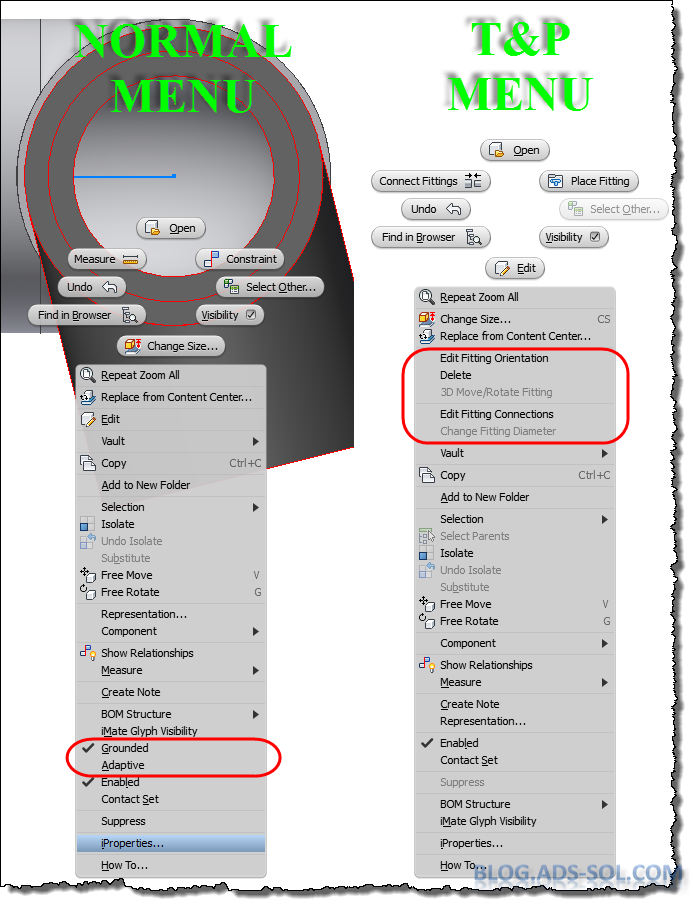
 Once you enter Tube and Pipe environment you will get customized menus, layouts and browsers so you the usual commands are not always there and for a reason I might add. While these commands are working you might brake T&P functionality and end up with unadaptive routes or even worse, crashes or corrupted files; none are fun to deal with so keep to the manual or standard procedures as much possible.

One of the missing commands is Grounded status on the right click menu, graphical window or browser. There is a reason for that, and we shouldn’t mess about with it but sometimes we have to and as long as you remember to tick it back on then we are ok.

T&P has custom menus, UI layouts and browsers.

Right click the part in the browser or graphical window, choose Occurrence tab and tick off Grounded then click OK.

Ground option is only available on iproperties.
Now you can constraint you fitting however you want it. I usually use the origin planes of the fitting and of the pipe or element right next to it.

Constrain the fitting to fix the orientation

Use the part iproperties to put the Grounded option back on and then click OK. Unfortunately there is no shortcut option to ground components but this is not that time consuming.

Delete the constraints you just created but notice that the part stays put because of the ground status.

And that’s how to align a weird angle fitting.

Later,
ADS.


Thursday, 12 November 2015

Insert Fittings

Inserting fittings is a nice way of adding members without breaking the route and without needing to fix constraints and dimensions.

What I like to do when I have a quick layout to do or a proposal, for which we NEVER have enough time to make it proper, is to cheat and bend the rules as much possible and Tube and Pipe is no exception.


If you’ve finished the route and you ready to place fittings, it’s easier not to drop them in the line, or create nodes but to use the Insert Fitting command.

Once I’ve done my route and proved that it’s a viable solution and that the installers will have enough room to fit it I then turn to starting adding fittings. I am talking about adding fittings like valves, pressure gages, sample points, etc. These are not placed in automatically with the Populate Route command.

If the route is fully constrained and populated it’s a royal pain to add more fittings. Dropping them in your assembly will create new nodes in the route but this process will delete constraints and dimensions and you need to do that extra work to get it back to fully constrained. This is a fully constrained sketch route going crazy with a single place fitting command.

Route going crazy with single fitting placed.

                This is when Insert Fitting comes into place. Use the Place Fitting command to add your parts but before you click to place it right-click in the graphical area and choose Insert Fitting. This will allow you to insert it next to an already existing fitting or between two existing fittings.

Insert Fitting on right click menu.
                If I have a valve to place I find a close nearby elbow or any other populated fitting and I drop it in there, and I keep inserting next to it the rest of the fittings like pressure gages, sample points, etc. I am only interested to show what else will be on that line and to get the BOM quantity and price as close as possible.

                If the fitting to place is already available in the assembly then select it first and use the Place Fitting command. If not, just start the command which will let you browse for a part on disk. With the place fitting command active right click on the graphical window and choose Insert Fitting. You can press Spacebar to change connecting point on the fitting before finalizing the command. Move your mouse pointer next to an existing fitting, and watch how the arrows are displaying indicating your connection and when you are happy with the results click to finalize the insert.

Insert Fitting doesn't break the route.
 TIP: Sometimes you will not be able to place all fittings. No matter how much I try, I can’t place some fittings that have been imported from step or fittings located in library and not in content center. They work fine in T&P but inserting them is not available. What I do is place a fitting that works like a tee, union, coupling etc. first and then drop my valve on top of the tee to replace it. At this point you will also get the rotation dialog allowing you to orient it as needed.

TIP: Make sure that the segment where you are inserting is long enough so that inserting the fittings will not violate minimum length rule.


                If you deal with Butt Welded fittings you won’t need this but if you work with other type of connection like the Socket Weld like I do then there are some limitations. Once the fitting is inserted you need to right click it and choose edit fitting connection. In the dialog you will have two connections, one to the pipe and one to the existing fitting where you inserted yours. Edit the one to the fitting and choose custom distance and enter 0. The fittings by default will engage as per the authoring info which will overlap them.

The other issue is that the pipe will be trimmed to the furthermost fitting last inserted and so you will lose all those small segments in between them and if you need to do a cross section in you drawing it will appear as they are butt welded and the missing pipe segments will also give you less quantity in the BOM and Parts List. This is not a problem for me since we don’t do cut-to-length lists or material lists and it’s only general layouts for installers to follow.


                And this is it; nice and simple to speed up those designs. Would love to see what tricks do you use to speed your work up.

Later,
ADS


Tuesday, 13 October 2015

Place Multiple Fittings

I use a lot of Georg Fischer fittings to do my plant layouts but not all have been properly dimensioned in the catalogue and because it would take too long to identify and create an ipart / content center family, I usually author and place them as individual fittings.

piping as an art?
I know that I lose the possibility to Change Size but it’s not taking long to change them with place fitting command. If I need to change size of a component I can right click, choose iproperties, copy the file path, use the place fitting command and paste the file path, double click on new size, and all this takes less than 5 seconds, almost as much as it would take to wait for the change size menu and the family table to show up.

Because the original files are provided in a neutral file format like STEP I need to open each and every, author it and save it to library and I found that it’s faster to do it from an assembly. I drag-drop the step files inside an empty assembly, then edit each in place, author it and then save the  files. I can also check them into Vault real quick this way.

Another reason for doing this in the assembly environment is to be able to set part number and description for all of them at once by copy paste from an excel file to the BOM window. You can of course change any other iProperties custom or not.

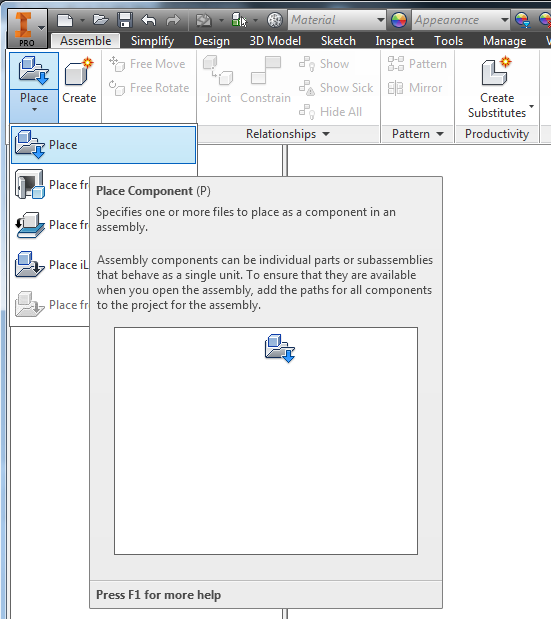
The other day I had to change description to all my ABS Socket Welded Check Valves so I started a new assembly and then used the place component command. In the select component window I have browsed to the library folder and selected all the valves but when you click OK Inventor will place just the first selected component because it’s an authored Tube and Pipe Fitting. Lazy as I am I didn’t’ wanted to kill my finger or the mouse so instead I have dragged them from windows explorer inside the assembly.


When you use the place command inside an assembly, if you have enabled the T&P add-in you will see that the parts come in as fittings (blue elbow icon on the browser). But if you drag-drop them from windows explorer they are placed as standard components. This will not affect them in any way and it's just a visual indication only.

So next time you need to edit a lot of fittings, or need to add a set to use in the assembly, remember to drag-drop them from windows explorer. Now you can edit them all at once form BOM editor or use the Place Fitting command on them rather than browse and select every time.


Later,
ADS

Thursday, 14 May 2015

Butt Fusion Fittings

Still buried with work and not sure if I’ll be able to do a video but at least you will have some quick info on how to do but fusion fittings and routes in general.


Depending on the complexity and detail you need there are a couple of approaches to take here. The simplest one would be to ignore the discrepancies before and after the pipe welding but you can take it all the way and create your excess welding material as ifeatures that you can drop on each fitting you author.
On my plant layouts I always ignore them because we tend to have plenty of space and discrepancies can be ignored. Quite simply on a 10 meter pipe the assemble tolerance will incorporate any variation from welding or thermal expansion.
So unless you’re into designing medical equipment or any other precise, tight tolerances equipment I would not bother. Keep this as a reference if every once in while you need to do renderings, or the client asks for these welds to be in place and ignore them the rest of the time.
On the simple side, quick and dirty if you do need to have proper, exact cut-to-length dimensions and BOM reports then you need to over-define your engagement dimensions so that the parts interfere therefore reporting correct pipe length and correct route dimensions, node to node.


If you do need to get all that detail exact and you have all the time in the world I would suggest you do the fusion as a ifeature that you can drop on each fitting. Make that ifeature table driven so you can choose and change size on the fly. You can take it down another level and calculate the lost volume from the cutout (melting) and generate your weld bead based on that but that’s way too granular for me.


If you need to author ipart fittings like elbows, tees, or anything else that has a table and might go to Content Center then define new planes driven by the fusion distance and set your engagement to plane/point so you can drive the engagement for each fitting diameter separately.


I recommend that you don’t change or re-author the pipe because you might use that pipe on different connection style (socket welding, jointed, etc.) and it will mess those up. Do all these changes on fittings and it will drive the pipe engagement as well.
Don’t just stop here use the over-engagement on compressed gaskets (thank you Chris Benner for the solution), expansion joints etc.
Here are a couple of links on Fusion Welding, general info and dimensions to help you on the process:
-          Local Head Loss in Polypropylene andPolyethylene Pipeline Joint Welded by Butt Fusion - Ing. Jaroslav VeselskýSupervisor & Prof. Ing. Jan Melichar, CSc.
-          Polyethylene Pipeline Systems - Avoiding ThePitfalls of Fusion Welding - Dr Chris O’Connor

And the post on Autodesk forum that generated this idea.


I have managed to do a video for my youtube friends. Not my best of works, you can hear I am tired and out of focus, apologies for that.


Later,
ADS.